Tickets resolved by agents who learn your product

AssistBPO's customer support outsourcing gives you dedicated support agents who work your ticket queue in Zendesk, Freshdesk, HubSpot, Gorgias or Intercom, resolve level 1 and level 2 issues and escalate cleanly. Each agent is an employee of the group, learns your product like a new hire would, and works your hours with a backup and a team lead.

  • Named assistant plus backup
  • Employed, screened, managed

Get a staffing plan

A named person replies within 1 business day

A short call sizes the desk faster than email. We call only if you leave a number.

  • A named assistant proposed within 72 hours
  • A person replies, not a bot
  • Details stored only to reply. Privacy

What is customer support outsourcing?

Customer support outsourcing is contracting an outside provider to staff your customer service: answering tickets, chats, emails and calls, resolving common problems, and escalating the rest to your internal team. At AssistBPO the agents are dedicated employees who work only your queue, in your tools and your hours, managed by a team lead who reports to you.

· Reviewed by Issabela Masters

  1. Customer support: what we do and how it runs

    Customer support outsourcing is contracting an outside provider to staff your customer service: answering tickets, chats, emails and calls, resolving common problems, and escalating the rest to your internal team. At AssistBPO the agents are dedicated employees who work only your queue, in your tools and your hours, managed by a team lead who reports to you.

    01 / 06
  2. What it is

    Customer support outsourcing is contracting an outside provider to staff your customer service: answering tickets, chats, emails and calls, resolving common problems, and escalating the rest to your internal team. At AssistBPO the agents are dedicated employees who work only your queue, in your tools and your hours, managed by a team lead who reports to you.

    02 / 06
  3. What you get

    Dedicated agents, not a shared queue, working inside your own help desk

    03 / 06
  4. How it runs

    Level 1 and level 2 resolution with escalation rules you approve

    04 / 06
  5. Match

    A 20-minute discovery call on channels, ticket volume, your help desk, product complexity and the hours to cover. Within 72 hours we propose named agents with relevant product or industry experience, plus a backup, and name the team lead who will run the desk.

    05 / 06
  6. A named assistant, a backup and a team lead

    In your hours, inside your tools, with a reply from a person within 1 business day. Call +1-657-777-0006 or ask for a staffing plan.

    Get a staffing plan 06 / 06
Self-playing walkthrough built from this page's copy, about 36 seconds. Static storyboard under reduced motion; every scene is readable without pressing play.

Who is the customer support desk for?

Ops and CX managers with a growing queue
Two to ten agents added under one team lead without a hiring round, a training program or a second office lease.
SaaS and software companies
Level 1 triage and level 2 how-to resolution from your help center, with bugs reproduced and passed to engineering in the format they want.
E-commerce and subscription brands
Order, shipping, returns and subscription tickets closed the same day, with peak-season agents added under the same lead.
Service firms with client desks
Client questions answered by one named agent who knows each account, so partners and account managers stop being the help desk.

What does the customer support service include?

These 12 tasks are what AssistBPO's customer support desk handles as standard for a support team lead.

  • Ticket triage, prioritization and routing in your help desk
  • Level 1 resolution from your knowledge base and macros
  • Level 2 how-to and account resolution for trained agents
  • Escalation to engineering, billing or management with full context
  • Multichannel coverage: email, chat, social and phone where needed
  • Knowledge base gaps logged and articles drafted for approval
  • Macro and saved-reply library maintained in your voice
  • Customer follow-up until each ticket is confirmed closed
  • CSAT and reopen tracking with weekly commentary
  • Peak, launch and outage surge coverage under the same lead
  • End-of-day report on volume, backlog and escalations
  • Monthly QA scorecard on accuracy, empathy and resolution

Deliverables and KPIs

AssistBPO reports 6 measures on the customer support desk: what lands on your desk, what we count, and how often you see the number.

DeliverableKPI we reportCadence
Tickets resolvedResolution rate, backlog ageDaily, in the end-of-day report
First response and full resolution timeAgainst the targets you setDaily and weekly
Escalations handed over cleanlyEscalation rate, time to hand-offWeekly review
Knowledge base improvementsArticles added or correctedMonthly
CSAT and reopensSurvey score, reopen rateWeekly
QA scorecardAccuracy, empathy, policy, resolutionMonthly

KPIs are what we measure and report, agreed per engagement in the weekly review. Service-level commitments are set in your agreement, not on this page.

How does the customer support desk work?

  1. Match

    A 20-minute discovery call on channels, ticket volume, your help desk, product complexity and the hours to cover. Within 72 hours we propose named agents with relevant product or industry experience, plus a backup, and name the team lead who will run the desk.

  2. Onboard

    Agents complete your product training, read your policies and macros, and work a shadow week where the team lead reviews every reply before it goes out. We agree escalation paths, refund limits and the ticket tags you want, then move to live tickets in stages.

  3. Daily rhythm

    Each agent starts by clearing the oldest and highest-priority tickets, works the queue through the shift, logs escalations with context and finishes with an end-of-day report: tickets closed, backlog age, escalations open and anything that needs your decision.

  4. Weekly review

    20 minutes with the team lead on volume, response times, ticket drivers, help center gaps and staffing for next week. Every month the team lead scores a random sample of tickets on the QA scorecard and shares the results with the agents and you.

Hours, coverage and models

AssistBPO staffs the customer support desk on 4 models. US, UK, Canadian and Australian business hours from the group's two offices. AEST night shifts and bilingual Spanish or French agents are available on request.

  • One dedicated support agent, 80 or 160 hours a month
  • Support pod of 3 to 10 agents with a team lead
  • Peak-season or launch surge agents under the same lead
  • Follow-the-sun coverage through the 24/7 support pod

See what is staffed in your zone on the coverage clock.

What are the terms on the customer support desk?

The card, the contract terms and the customer support desk's own numbers, in one place.

What are the terms on the customer support desk?
SpecificationWhat you get
Focus, 20 hours a week$800 a month, 80 hours
Dedicated, 40 hours a week$1,600 a month, 160 hours
Managed Pod, three seats or moreFrom $4,800 a month
Evening, weekend or overnight coverTier rate plus 20 percent
DeskCustomer support desk
Standard scheduleOne dedicated support agent, 80 or 160 hours a month
CoverageUS, UK, Canadian and Australian business hours from the group's two offices.
Tools10 platforms, including Zendesk, Freshdesk, HubSpot
KPIs reported6 measures: daily, weekly, monthly
Setup feeNone
Minimum termMonth to month, no lock-in
Notice30 days, to stop or to change hours
If the fit is wrongTrained backup covers the desk the same day, re-match at no charge
ContinuityOne named assistant, one named backup, one team lead
Who does the workEmployed by SS Support Network LLC, never freelancers or contractors

These are rate-card starting points. What you pay depends on the hours, the desk and the coverage window, which is what the staffing plan sets. Rates improve as you add assistants. Your staffing plan states the rate for the number of seats you need. The rate card carries the other currencies, the add-ons and the six things that move a plan off it.

How much does customer support cost?

Plans start at $400 a month for 40 hours, at $10 an hour, and rates improve as you add assistants. Get a staffing plan within 1 business day.

What moves the plan

  1. Hours a week and whether the desk is dedicated or shared
  2. Phones: live answering needs a receptionist profile and a backup
  3. Coverage zone: business hours, after-hours, weekends or 24/7
  4. Tools and access to set up
  5. One person or a pod with a lead

What the market publishes

Other providers' published ranges, by market, so you have something to hold this against. These are not AssistBPO prices.

Third-party published rates by market, dated, for orientation only
MarketPublished rangeSource
United StatesManaged offshore staff $640 to $2,400 a month full time; a loaded in-house hire runs $4,700 to $9,100 a month; turnover of a marketplace-hired VA costs 2 to 3 months of salary in lost productivityWishup, Cherry Assistant and Marblism cost guides, 2026; Zedtreeo and Catalyst on turnover, 2026
United KingdomOffshore full-time staff £900 to £2,000 a month against £3,000 to £5,000 for a UK-based employee; PayScale employed assistant average £15.33 an hourOutsource Accelerator, Time etc and PayScale UK, 2026
AustraliaFull-time offshore staff A$22,000 to A$35,000 a year against A$91,000 or more for a loaded local employeeVirtual Coworker, Remote Staff and Smart Staffing published figures, June to August 2026
GlobalHuman virtual assistant and remote staffing market $6.5 billion in 2026, growing at 23.4 percent a year to 2035; SMBs are 44 percent of buyersWishup 2026 Industry Report; Future Market Insights via Call Force, 2026

Get a staffing plan How we build a plan

Proof

Case study

One engagement on this desk, anonymized. Numbers appear only once the owner has verified them.

All case studies

Peak season handled without a backlog

Case study

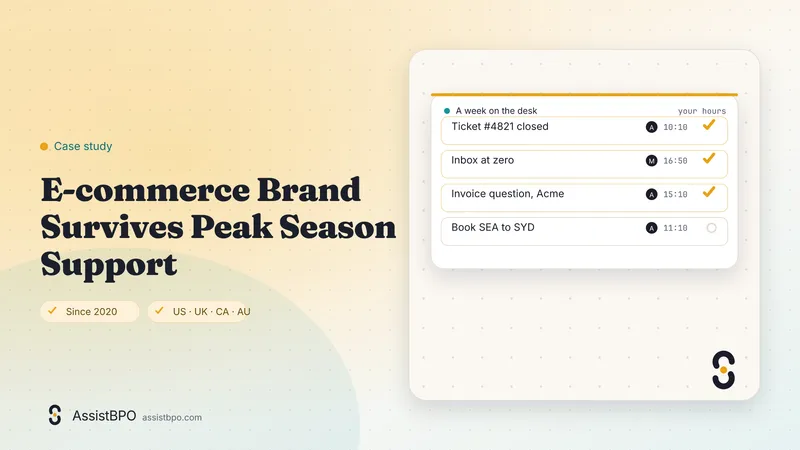
E-commerce Brand Survives Peak Season Support

A direct-to-consumer brand selling on Shopify did most of its year in six weeks. The rest of the year two people cleared the queue comfortably. In peak season the same two people were answering chat, email, Instagram messages and returns at once, first response times stretched into days, and shipping-delay questions arrived faster than anyone could answer them. Temporary hires had never worked out, because training finished about the time the season did. AssistBPO built a peak-season pod on the support desk: named agents with a team lead, trained in October, live from the start of November and stood down in January. The pod worked inside the brand's own Gorgias help desk using macros written with the in-house team. Tickets were tagged by reason so the operations team could see which problems were worth fixing at the source.

Consumer e-commerce

Security and compliance

  1. Every agent is an employee of the group, background checked and under NDA before touching a ticket
  2. Least-privilege seats in your help desk and admin tools, revoked the day an agent leaves the desk
  3. Managed workstations with MFA, disk encryption and no local storage of customer records
  4. No full card numbers, passwords or one-time codes are ever collected in tickets
  5. Secure workspace policy in both offices and an incident-response plan you can read on the security page

Full control list on the security page and country rules for calls, texts and email on the compliance page. Certifications are listed only when held.

Country rules for this service

AssistBPO makes outbound calls, texts and emails only with lawful consent and do-not-call scrubbing. Assistants never take card numbers. Country rules.

  • US: PCI DSS scope stays with your payment portal; agents never see full card numbers
  • UK and EU: UK GDPR and a data processing agreement with international transfer terms before go-live
  • Healthcare clients: HIPAA-trained staff and a BAA through SS Support Network, the group's healthcare desk

Frequently asked questions

How much does customer support outsourcing cost?

Plans depend on hours, desks and coverage. Get a staffing plan within 1 business day. To orient you, 2026 cost guides put a managed offshore staff member at $640 to $2,400 a month full time, while a loaded in-house hire in the US runs $4,700 to $9,100 a month (Wishup, Cherry Assistant, Marblism). AssistBPO prices per agent for a block of hours, with the backup, team lead, QA and reporting included rather than billed as extras.

Do the agents work only for us?

Yes. A dedicated agent works your queue and nobody else's, which is how they learn your product, your customers and your edge cases. Pods of three or more get a team lead who is also dedicated to your account. We do not run a shared floor where one person answers for many brands, because that is where tone slips and product knowledge stays shallow.

What is the difference between level 1 and level 2 here?

Level 1 is triage and known answers: password resets, order status, how-to questions, policy explanations, anything your knowledge base already covers. Level 2 is diagnosis: reproducing a bug, checking account settings, walking a customer through a configuration or deciding which refund policy applies. Agents start on level 1, are certified by the team lead on level 2 after training, and level 3 stays with your engineers or specialists.

How long does it take to get agents live?

Discovery to a named proposal is 72 hours. Onboarding depends on product complexity: a store with clear policies can be live in about a week, while a software product with a deep help center usually needs two to three weeks of training and shadowing. We would rather add a few days of shadow time than let an undertrained agent talk to your customers.

Which help desk and channels can you cover?

Zendesk, Freshdesk, HubSpot Service Hub, Gorgias, Intercom and Help Scout are the platforms we work in most, and agents can cover email, live chat, social inboxes and phone from the same queue. You keep the accounts and the data; agents use seats you create. If you have no help desk yet, we can recommend one for your volume and set it up during onboarding.

How do you keep quality up over time?

Three habits. The team lead samples tickets every week and scores a bigger random sample on the monthly QA scorecard for accuracy, empathy, policy and resolution. Any correction you send becomes a macro or knowledge base fix the same day. And the weekly review looks at reopens and CSAT comments, so a slipping metric is caught in days rather than at a quarterly business review.

What happens when a customer needs something the agent cannot do?

The agent follows the escalation map we build in onboarding: who owns billing disputes, technical bugs, legal threats or press inquiries, and how urgent each is. The customer gets a holding reply with a realistic timeframe, and the ticket is handed over with a summary, account details and steps already tried. Open escalations stay on the end-of-day report until the owner closes them.

Can you scale up for a launch or the holidays?

Yes. Tell us the dates and the expected multiple of normal volume. Surge agents are trained on the same macros by the same team lead, join the queue for the period you need and roll off afterwards. Because the core agents stay, your customers still meet people who know the product, and the temporary agents take the simpler tickets while the queue is high.

Is the support delivered under our brand?

Always. Agents sign as your team, use your email domain and signatures, follow your tone guide and never mention AssistBPO to a customer. Your help desk, your macros and your customer data stay in your accounts. If a customer asks where the agent is based, the agent answers honestly and briefly, then gets back to solving the problem in front of them.

Should we hire support agents in-house instead?

Price a whole desk rather than one seat. A loaded in-house hire in the US runs $4,700 to $9,100 a month (Wishup, Cherry Assistant and Marblism, 2026), and that figure carries none of the hiring round, the training program, or what happens to the queue when one of your two agents takes leave. Outsourcing buys the backup and the team lead alongside the seat. Keep it in-house when the product is specialized enough that training runs for months, or when agents have to sit beside engineering to be useful at all.

What if our ticket volume drops after peak?

Surge agents roll off once the backlog is back to normal, which is how the peak plan is built in the first place. The core desk runs month to month, with thirty days notice to stop or to change the hours, so a 160-hour agent can drop to 80 without a new match or a new training round. The thing worth keeping through a quiet quarter is the weekly review, because that is when knowledge base gaps get closed while there is still time to close them.

What should we watch in the first 90 days?

Reopen rate before CSAT. A reopened ticket means the first answer was wrong or incomplete, and it moves weeks before a survey score does. After that: backlog age rather than ticket count, because ten week-old tickets are a worse problem than fifty from this morning; escalation rate, which should fall as agents are certified on level 2; and the count of knowledge base articles added, which is the clearest sign the desk is learning your product instead of guessing at it.

Ask an AI assistant to summarize this page

Next step

Your desk, staffed. Wherever you are.

Tell us what is overloaded. A named person replies within 1 business day with a staffing plan, and we propose your assistant within 72 hours.

Get a staffing plan Book a 20-minute call

Or call +1-657-777-0006 during US, UK or Australian business hours, or hear our demo receptionist.

  • A named assistant proposed within 72 hours
  • Employed, screened and managed staff, never freelancers
  • Your hours, your tools, your data
Call WhatsApp Staffing plan