How to outsource customer service without losing customers comes down to sequencing. Write your top 20 answers, set a written authority level, then move one queue at a time across four gated weeks: shadow, draft, ship low-risk, own. The 30-day plan below is the version that survives contact with real tickets.
What actually breaks when you outsource support?
Four things, and none of them is the agents.
Missing knowledge. Your answers live in your head and in a hundred sent replies. Nobody can reproduce them from a product tour.
No authority. An agent who cannot approve a $40 refund escalates everything, response times collapse, and customers feel handed around.
Too many channels at once. Email, chat, social and phone launched together means none of them gets a proper ruleset.
No listening loop. Voice and accuracy drift quietly in week three. Without a weekly review of real tickets, you find out from a review site.
The good news is that all four are fixable before day one, and none of them costs money to fix.
What has to exist before day 1?
Build these six artifacts first. Two days of work, and they are the difference between a smooth month and a bad one.
- Top 20 questions and answers. Pull them from your help desk’s most common tags. Write the reply you would send, word for word.
- Macro library. Convert those 20 into macros in Zendesk, Freshdesk, Gorgias, Help Scout or whatever you run. Name them so they are findable under pressure.
- Authority matrix. What an agent can decide alone, what needs a lead, what comes to you. Put dollar amounts on it.
- Escalation rules. Five named triggers, a named owner for each and a time by which the customer hears back.
- Voice guide. Built from 30 of your own replies, written by the team and corrected by you.
- Definition of done. What a good ticket looks like: answered the question, confirmed the next step, tagged correctly, no reopen.
What does the 30-day plan look like?
Each week has a gate. If the gate is not met, repeat the week rather than moving on. Repeating week two is cheap; losing customers in week four is not.
| Week | Focus | The team does | You do | Gate to pass |
|---|---|---|---|---|
| 1 | Shadow and learn | Read 100 closed tickets, write the first draft of the knowledge base, sit in on calls | 60 minutes a day of walkthroughs and Q and A | 20 macros drafted and approved; product quiz passed |
| 2 | Draft only | Draft replies on real tickets, nothing sends without approval | Review every draft, log each correction as a new macro or rule | 90 percent of drafts approved with no edit for two days running |
| 3 | Ship low risk | Send unsupervised on status, how-to, returns within policy and billing lookups | Spot check 10 tickets a day, hold a daily 15-minute review | Reopen rate under 10 percent; no voice complaints |
| 4 | Own the queue | Own one full queue end to end, including tagging and reporting | Read the end-of-day report, review 10 tickets a week, run the weekly review | First response and resolution times inside target for five days |
Week 1: shadow and learn
Give access on day one and resist the urge to start with tickets. The most valuable week-one output is not replies, it is the knowledge base the team writes by reading your history. Have them draft it and send it to you for correction.
End the week with a short product quiz you wrote yourself, 20 questions, and a list of the things they could not find an answer to. That list is your real knowledge gap.
Week 2: draft only
Every reply is drafted and approved before it sends. This feels slow and it is the cheapest quality control you will ever run: mistakes never reach a customer, and every correction becomes a permanent rule. Set the discipline that no correction is given twice verbally. If you correct something, it goes into a macro, the voice guide or the authority matrix the same day.
Watch the correction curve. It should fall steeply between day 8 and day 12. If it is flat, the knowledge base is the problem, not the agent.
Week 3: ship low risk
Open the gate one category at a time: order and job status first, then how-to, then returns and rebookings inside policy, then billing lookups. Each category gets its own go-live and its own 48-hour watch. Keep everything that touches cancellations, anger or money above your threshold in your own queue.
This is the week to make the authority matrix real. An agent who can issue the refund, reship the item or rebook the appointment without asking will resolve in one touch, and one-touch resolution is what customers actually experience as good service.
Week 4: own the queue
Hand over one complete queue, including tagging, reporting and the end-of-day summary. Your job moves from reviewing work to reading numbers. The daily report should list tickets handled, anything waiting on you, escalations with a one-line summary, and tomorrow’s plan.
Book the weekly review now: 20 minutes with the team lead on four numbers, three ticket examples and one process change. That meeting is what stops month two drifting.
Which numbers tell you it is working?
Four, reviewed weekly. Set targets before day one so nobody negotiates them later.
| Metric | What it measures | Sensible starting target |
|---|---|---|
| First response time | Whether customers feel attended to | Under 4 hours on email, under 60 seconds on chat |
| Resolution time | Whether the answer actually lands | 90 percent inside your published target |
| Reopen rate | Quality of the answer, the real signal | Under 10 percent, falling |
| Escalation rate | Whether the authority matrix is working | Under 15 percent by week four |
Reopen rate is the one to watch. First response time is easy to make look good with a holding reply, and a rising reopen rate is what tells you the team is closing tickets rather than solving problems. If reopens climb while response times improve, tighten the definition of done before you praise the dashboard.
What stays in house for the first quarter?
Five categories, and a plan to move three of them in month four.
- Cancellations and saves. Needs commercial authority and product depth.
- Angry escalations above your threshold. Needs someone who can make an exception.
- Anything legal, regulatory or safety related. Named owner, same day.
- Press, public reviews and social complaints. Draft by the team, sent by you at first.
- Your top accounts. Name them explicitly in the escalation rules.
Reassess at 90 days. By then, reviews and low-value saves usually move across comfortably; legal and top accounts rarely should.
What does it cost to outsource customer service?
Price the hours and the coverage window rather than a per-ticket headline. For a market anchor, PayScale puts US assistants at $19.45 an hour and Indeed at $27.15, while the Wishup 2026 cost guide puts managed offshore staff at $7 to $15 an hour, or $640 to $2,400 a month full time. The Wishup 2026 industry report sizes the human assistant services market at $6.5 billion in 2026, growing at 23.4 percent a year, which is why the supply of experienced support staff has improved.
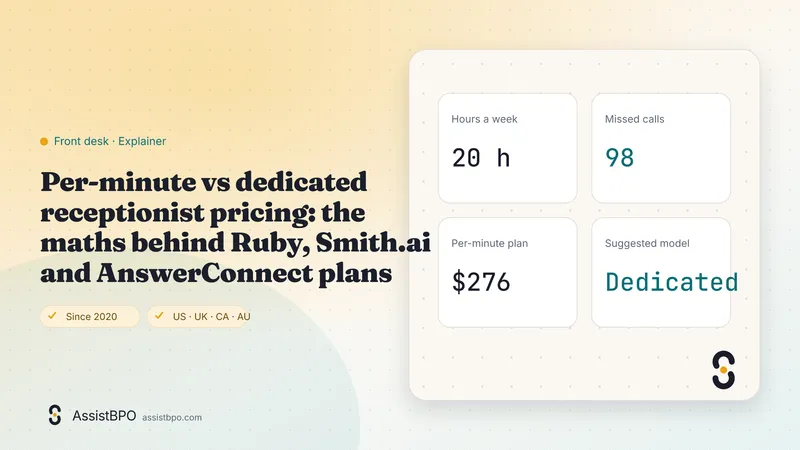
If phones are part of the queue, compare against answering plans as well. OnceHub’s September 2026 roundup puts human plans at roughly $235 a month for 50 minutes up to $1,095 for 500 minutes, with overage at $2.95 to $4.70 a minute, and the BLS Occupational Outlook Handbook gives a median US receptionist wage of $38,010 a year before benefits, based on May 2025 data. Once talk time is steady above about 900 minutes a month, a flat-rate person is usually cheaper than a per-minute plan.
AssistBPO staffs dedicated, employed support agents who work in your help desk, learn your macros and report daily to a team lead; see customer support outsourcing. Plans depend on hours, desks and coverage. Get a staffing plan within 1 business day.
The short version: write the answers first, gate each week, give agents real authority, start on one channel, and judge the month on reopen rate rather than response time.
Frequently asked questions
How do I outsource customer service without customers noticing?
Give the team your answers, not just your product. Write the top 20 questions and the exact reply you would send for each, then convert them into macros. Set a written authority level so agents can resolve rather than escalate. Start on one low-risk queue and expand weekly. Customers notice tone and delay, not org charts, so protect response time and voice above everything else in month one.
How long does it take before an outsourced team is productive?
Two weeks to useful, four to independent, about 90 days to genuinely good on a product of normal complexity. Week one is shadowing and reading. Week two is drafting with every reply approved. Week three is shipping low-risk categories unsupervised. Week four is owning a queue with spot checks. Expect month one to be slower than doing it yourself; that is the investment, not a warning sign.
What should stay in house?
Cancellations and saves, angry escalations above a threshold you set, anything legal or regulatory, press and public complaints, and your largest accounts. Those need context and authority that take longer than 30 days to transfer. Everything else, meaning status questions, returns within policy, how-to help, billing lookups and order changes, can move in the first month with the right macros.
How do I keep brand voice consistent?
Build the voice guide from your own replies. Give the team 30 of your best sent tickets, ask them to write the rules they can see, then correct their version. Add three explicit lines: typical reply length, words you never use, and how you apologize. Review ten tickets a week against it for the first month. Voice drifts quietly, so a weekly listening loop matters more than a long document.
Should I start with email, chat or phone?
Email or tickets first. The queue is asynchronous, so a new agent can check before replying and you can review before anything ships. Chat is next, because it needs product fluency at speed. Phone last, unless phones are the whole reason you are outsourcing. Adding all three in week one is the single most common way a 30-day plan turns into a bad quarter.
Sources
- Wishup, The 2026 Virtual Assistant Industry Report
- Wishup, How much does a virtual assistant cost (2026 cost guide)
- PayScale, Virtual Assistant hourly rate, United States
- Indeed, Virtual assistant salary in United States
- US Bureau of Labor Statistics, Occupational Outlook Handbook, Receptionists
- OnceHub, Answering service cost in 2026