-
Assistants for law firms: how the pod runs
A legal virtual assistant from AssistBPO is a named, employed assistant who runs client intake, conflict checks, calendaring, e-filing prep, document management and billing entry for law firms, in your hours. One person learns your practice areas, your Clio or MyCase setup and your court deadlines, with a trained backup and a team lead behind them.
01 / 06 -
What we handle
A legal virtual assistant from AssistBPO is a named, employed assistant who runs client intake, conflict checks, calendaring, e-filing prep, document management and billing entry for law firms, in your hours. One person learns your practice areas, your Clio or MyCase setup and your court deadlines, with a trained backup and a team lead behind them.
02 / 06 -
Phones and admin together
Intake, conflict checks and calendaring inside Clio, MyCase or Lawmatics
03 / 06 -
In your hours
No legal advice, no signing or filing where a license is required
04 / 06 -
What you see
Employed assistants under NDA, trained on ABA confidentiality duties
05 / 06 -
A named assistant, a backup and a team lead
In your hours, inside your tools, with a reply from a person within 1 business day. Call +1-657-777-0006 or ask for a staffing plan.
Get a staffing plan 06 / 06
· Reviewed by Issabela Masters
What can law firms hand off first?
These 8 jobs are what AssistBPO's Legal pod takes off law firms first.
Client intake
Answer the intake call or web form, run the conflict check against your matter list, collect the facts on your questionnaire, send the engagement letter for the attorney's signature, and open the matter in Clio or MyCase once it is countersigned.
Conflict checks
Search every new party, adverse party and related entity against your conflicts database before any substantive detail is taken, and log the result on the matter so the attorney clears it in writing.
Calendaring and deadlines
Enter court dates, statute of limitations dates, discovery cutoffs and response deadlines from each scheduling order with the reminder ladder you set, and reconcile them against the court's docket every week.
E-filing prep
Assemble the filing packet: format the caption, check page limits and exhibit labels, convert to text-searchable PDF, prepare the certificate of service, and stage it in the e-filing portal for the attorney to review and submit.
Document management
Name, tag and file every pleading, letter, exhibit and email to the right matter folder in NetDocuments, Clio or SharePoint using your naming convention, and keep the matter index current.
Billing entry
Turn attorney notes, call logs and calendar entries into time entries with the right task codes, apply your billing guidelines, prepare draft prebills for review and send approved invoices through your practice management system.
Client communication
Status updates, document requests and appointment reminders sent in the firm's name from approved templates, with anything that asks for an opinion routed to the attorney with the matter open.
Discovery and records support
Send records requests, track responses, Bates-label productions, build privilege log spreadsheets from attorney designations and keep the production index current.
What does a typical week look like for law firms?
Monday
Weekend intake forms and voicemails returned before 9am, conflict checks run on each new inquiry, and the week's court dates and response deadlines listed by attorney.
Tuesday
Engagement letters chased, new matters opened in Clio with the intake documents attached, medical and public records requests sent and logged.
Wednesday
Filing packets assembled for Thursday and Friday deadlines, exhibits labeled, certificates of service drafted, and the docket reconciled against the calendar.
Thursday
Time entries from the week's notes and call logs entered and coded, prebills prepared for attorney review, client status updates sent from approved templates.
Friday
Approved invoices sent, unpaid balances flagged for the attorney, next week's hearings, depositions and consults confirmed with clients, and the matter list report delivered.
Legal software we work in





Also in use
Which assistant roles do law firms use?
AssistBPO builds the Legal pod from the 6 roles below, each one employed and managed rather than contracted.
-
Takes the first call or form, runs the conflict check, completes the intake questionnaire and books the consultation with the right attorney.
-
Calendaring, document management, e-filing prep, billing entry and the client updates that keep matters moving.
-
Answers in the firm's name, screens for existing matters, takes messages with matter numbers and warm-transfers by attorney rule.
-
Time entries, contact and matter records, medical records indexes and discovery logs entered with a second check on every batch.
-
Paralegal support assistant
Document assembly from your templates, records requests, exhibit prep and production indexes under attorney supervision; no legal judgment.
-
Executive assistant to the managing partner
Inbox, calendar, CLE tracking, vendor invoices and firm admin so the partner bills instead of administers.
Which compliance rules apply to law firms?
The rules your pod is trained on before the first live shift, and the ones the team lead checks in the monthly QA scorecard.
Confidentiality under ABA Model Rule 1.6
Every assistant works under NDA and the confidentiality obligations your state bar extends to nonlawyer staff through ABA Model Rules 1.6 and 5.3, on a managed device with MFA and no local storage. Client files stay in your practice management system, and access runs through your own user accounts so you can revoke it in a minute.
No legal advice, no unauthorized practice
Assistants never give legal advice, interpret a document for a client, set fees or predict outcomes. They do not sign or file anything where a license or attorney signature is required; filings are staged for the attorney to review and submit. Your state's unauthorized practice of law rules, enforced by the state bar or supreme court, draw the line and we stay on the admin side of it.
State bar advertising rules for outreach
Follow-up emails, social posts and any contact with prospective clients follow ABA Model Rules 7.1 to 7.3 and your state bar's advertising rules: no misleading claims, no specialist claims without certification, required disclaimers and the firm's name on every message. There is no live solicitation of strangers; calls go only to people who contacted the firm first, with lawful consent and do-not-call scrubbing.
Trust accounting stays with the firm
Assistants prepare billing entries and invoices but never move money in the IOLTA trust account, issue trust disbursements or reconcile trust ledgers. Trust accounting rules under your state bar remain the attorney's responsibility; we keep the time and billing records that feed them accurate.
KPIs we report
AssistBPO reports 6 KPIs on the Legal pod.
| KPI | Why it matters |
|---|---|
| Intake response time | Minutes between a web form or call and the first human response, because the prospective client who does not hear back calls the next firm. |
| Conflict checks cleared before consult | Share of consultations held with a cleared conflict check on the record, so no attorney learns facts they cannot un-know. |
| Deadlines entered same day | Court dates and response deadlines calendared the day the order or pleading arrives, reconciled weekly against the docket. |
| Billable hours captured | Time entered against time worked, because the entry written up on Friday from memory is the one that gets cut. |
| Days from prebill to invoice | How long draft bills sit with attorneys before going out, which is where cash flow leaks. |
| Filing packets returned for correction | Filings the attorney sends back for formatting, exhibit or service errors, tracked on the monthly QA scorecard. |
Case study
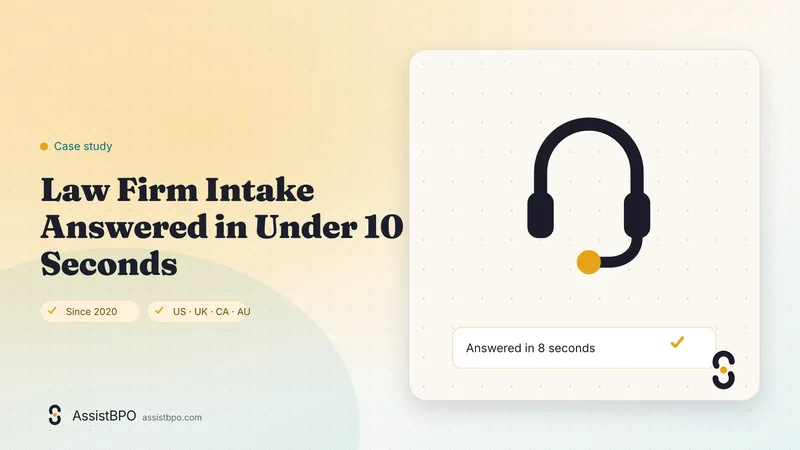
New matters captured on the first call
Case studyLaw Firm Intake Answered in Under 10 Seconds
A personal injury and family law practice in the US Northeast had one paralegal covering reception between her own case work. New inquiry calls landed while she was on another line or in a meeting, and a caller who reaches voicemail with a legal problem usually calls the next firm rather than waiting. Intake notes varied by whoever took the call, so conflict checks and consult bookings often needed a second conversation. AssistBPO put a named legal receptionist on the line with a trained backup and a team lead, working in the firm's own case management system during office hours and on an after-hours desk in the evenings. Every new inquiry now follows one intake script, gets the conflict-check details captured before anything else, and either books a consult or is declined politely with a referral note.
Services for law firms
Each one is written for this sector: its tasks, its KPI and a scenario from this industry rather than a general description.
- Virtual assistant services for law firms
- Virtual receptionist services for law firms
- Appointment scheduling service for law firms
- Customer support outsourcing for law firms
- Email management virtual assistant for law firms
- Calendar management services for law firms
- Data entry services for law firms
- Appointment setting services for law firms
- CRM virtual assistant for law firms
- Social media virtual assistant for law firms
- After hours answering service for law firms
- Client intake services for law firms
Guides for law firms
Written for this sector: the tasks, the rules and the numbers, with every source named.
- Legal intake outsourcing: how law firms answer in seconds and qualify every lead Legal intake outsourcing explained: the intake script, conflict-check data capture, speed to lead and how trained staff work inside Clio and Lawmatics.
- How to write a phone script your receptionist can actually use (10 industry templates) A receptionist phone script template with a six-block structure, plus 10 short industry scripts for dental, legal, HVAC, real estate, salon and more.
- The whole library
Frequently asked questions
How much does a legal virtual assistant cost?
Plans depend on hours, desks and coverage. Get a staffing plan within 1 business day. For orientation, published US virtual assistant pay averages $19.45 an hour (PayScale via Wishup, 2026), and managed offshore assistants are typically quoted at $640 to $2,400 a month full time. A dedicated legal assistant is priced per person for a block of hours, so a heavy litigation month does not change the bill, and there is no per-minute meter on intake calls.
Is a legal virtual assistant the same as a paralegal?
No. A paralegal virtual assistant from AssistBPO handles the administrative side of legal work: intake, calendaring, document management, e-filing prep, records requests and billing entry. Substantive paralegal work that requires legal judgment, such as drafting pleadings from scratch or research you rely on, stays with your licensed staff. Where a task sits in between, such as assembling a motion from your template with attorney-provided content, the assistant does the assembly and the attorney reviews every word before filing. ABA Model Rule 5.3 makes the supervising lawyer responsible for nonlawyer assistants, and our process is built to make that supervision easy.
Can the assistant give clients legal advice or sign documents?
No, on both. Assistants relay facts from the file, such as the next hearing date or which documents are still outstanding, and route any question about what a client should do to the attorney. They never sign pleadings, engagement letters or filings, and never submit a filing where the rules require an attorney to do so. E-filing packets are assembled and staged in the portal, and the attorney reviews and submits. The unauthorized practice of law rules in your state set the boundary, and your team lead keeps a copy in the assistant's playbook.
How do you keep client information confidential?
Every assistant is an employee of the group, background-checked, under NDA, and trained on the confidentiality duties your state bar extends to nonlawyer staff under ABA Model Rules 1.6 and 5.3. Work happens on managed devices with MFA and no local file storage, inside your own Clio, MyCase, NetDocuments or Microsoft 365 accounts, so nothing leaves your systems. Access is granted per user and can be revoked in minutes. If a matter must be walled off from a particular assistant because of a conflict, the team lead sets the restriction in your system before any work starts.
Which legal software do your assistants know?
Clio Manage and Clio Grow, MyCase, Lawmatics, PracticePanther, Smokeball, CosmoLex, Filevine and Litify for practice management and intake; NetDocuments, iManage and SharePoint for documents; the state and federal e-filing portals your firm uses; Microsoft 365 and Google Workspace; RingCentral and Dialpad for phones. If your firm runs something else, your team lead records the process during onboarding and the assistant learns it in the first week, always inside your own user account with the permissions you choose.
Can the assistant call prospective clients?
Only people who contacted your firm first, such as a web form, a chat or a missed call, and only with lawful consent and do-not-call scrubbing. We do not make live solicitation calls to strangers, because ABA Model Rule 7.3 and your state bar's rules restrict it. Follow-up messages carry the firm's name, avoid outcome promises and include any disclaimer your state requires on written communications to prospective clients. Your team lead keeps your state's advertising rule in the playbook, and every new template is approved by an attorney before use.
What hours does a law firm virtual assistant work?
Your hours. Most firms take a 9 to 6 desk in their own time zone, so intake, calendaring and billing entry happen while attorneys are in court or with clients. Firms with heavy intake add an evening and weekend answering desk so an injured caller or a family in crisis reaches a person; the desk leaves a morning handover note with each call and every consult booked. Deadline-heavy weeks can be covered by the trained backup at short notice, and the team lead adjusts hours in the weekly review.
How is billing entry handled without an attorney's judgment?
The assistant captures, codes and formats; the attorney decides. Notes, call logs, calendar entries and email threads are turned into time entries with the client's task codes and your billing guidelines, such as minimum increments, block-billing bans and narrative style. Prebills go to each attorney for review, and edits are applied before invoices leave. The assistant chases missing time each week and flags unbilled work, but never adjusts rates, writes down time or touches trust funds. Your bookkeeper handles the accounting side; the assistant keeps the time and billing records feeding it accurate.
Ask an AI assistant to summarize this page
Opens the assistant with a prefilled prompt so you can check our claims against the page yourself.