Virtual assistant vs answering service is really a question about what happens after the phone stops ringing. An answering service answers and takes a message, billed per minute or per call. An AI receptionist does the same for a flat fee. A dedicated virtual assistant answers, then books, follows up and clears the admin. Which one fits depends on your call volume, call type and how much work sits behind each call.
What is each option, in one paragraph?
Answering service. A shared team of receptionists answers your line in your business name, follows a short script, takes messages, transfers calls and often books appointments. You pay for minutes or calls used. Ruby, Smith.ai, AnswerConnect, Moneypenny and Abby Connect are the names most buyers compare. Coverage is usually 24/7 and the receptionists are shared across many clients.
AI receptionist. Software that answers the phone with a synthetic voice, understands common requests, answers questions from a knowledge base, takes messages and books into a connected calendar. You pay a flat monthly fee. OnceHub’s 2026 roundup puts these at $25 to $300 a month.
Dedicated virtual assistant. One named, employed person who works your hours, answers the phone as part of a wider role, and handles the inbox, calendar, CRM, quotes and follow-up in between. Priced as a monthly plan for a block of hours, with a backup and a team lead when the provider is a managed service. See virtual receptionist services for what the phone side of that role includes.
How do the three compare side by side?
| Criterion | Answering service | AI receptionist | Dedicated virtual assistant |
|---|---|---|---|
| How you pay | Per minute or per call, with overage | Flat monthly fee | Flat monthly plan for a block of hours |
| Published cost, 2026 | About $235 for 50 minutes to $1,095 for 500 minutes; $2.95 to $4.70 a minute over (OnceHub) | $25 to $300 a month (OnceHub) | Managed assistants $640 to $2,400 a month full time (Wishup) |
| Who answers | A shared pool, whoever is free | Software | The same named person every day, with a backup |
| Knows your business | Script-deep | Knowledge-base-deep | Learns your clients, tools and preferences |
| Hours | 24/7 standard | 24/7 | Your business hours; after-hours as an add-on |
| Books appointments | Usually, in your calendar link | Yes, from a connected calendar | Yes, in your calendar or practice system, with reminders |
| Admin between calls | No | No | Yes: inbox, CRM, quotes, follow-up, reporting |
| Handles exceptions | Limited to the script and escalation rules | Weak; hands off or loops | Yes, with judgment and your escalation tree |
| Outbound calls | Some, as a paid add-on | Limited | Yes, with lawful consent and do-not-call scrubbing |
| Sensitive industries | With a BAA and trained staff, at some providers | Risky for health and legal detail | HIPAA-trained staff and a BAA available; intake scripts per industry |
| Best fit | Low or spiky volume, overflow, nights | Routine calls, tight budget, simple booking | Steady volume plus real admin behind each call |
The table shows the shape of the decision. The answering service and the AI receptionist are answer-and-hand-off products. The assistant is an own-the-outcome product. Neither is better in the abstract; they solve different problems.
How much does each one cost at your call volume?
Published tiers make this easy to model. The figures below use the entry plan and overage rate from OnceHub’s September 2026 roundup and the providers’ own pricing pages (Ruby, AnswerConnect). They are worked examples, not quotes, and the providers publish intermediate plans that may land lower.
| Monthly minutes | Per-minute service (Ruby entry plan plus overage, or the 500-minute plan where cheaper) | Per-minute service (AnswerConnect entry plan plus overage) | AI receptionist (flat) |
|---|---|---|---|
| 100 | $235 + 50 × $4.70 = $470 | $325 | $25 to $300 |
| 300 | 500-minute plan, $1,095 | $325 + 200 × $2.95 = $915 | $25 to $300 |
| 800 | $1,095 + 300 × $4.70 = $2,505 | $325 + 700 × $2.95 = $2,390 | $25 to $300 |
| 1,500 | $1,095 + 1,000 × $4.70 = $5,795 | $325 + 1,400 × $2.95 = $4,455 | $25 to $300 |
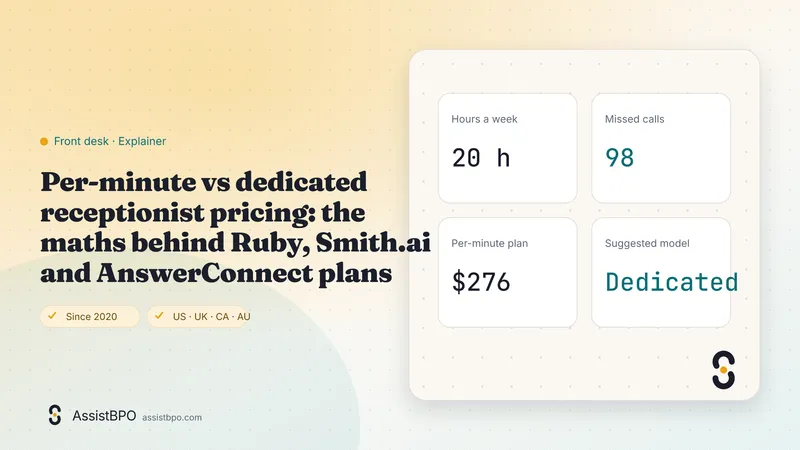
Set that against two human benchmarks. The BLS Occupational Outlook Handbook gives a median in-house receptionist wage of $38,010 a year (May 2025 data), roughly $3,170 a month before benefits, and the Wishup 2026 cost guide puts a managed full-time remote assistant at $640 to $2,400 a month. At 800 minutes a month, the per-minute plans in the table cost about the same as a full-time dedicated person who also does the admin. At 1,500 minutes, the per-minute plans cost more than an in-house receptionist.
Three cautions. Per-minute plans usually round up, so short calls cost a full billing increment. Smith.ai prices per call instead (about $292 for 30 calls with $9.75 a call over, per OnceHub), which favors long calls and penalizes short ones. And the AI line looks unbeatable on price, but it only wins if the calls it takes are the calls you can afford to have handled by software.
AssistBPO prices the dedicated option as a plan rather than a meter. Plans depend on hours, desks and coverage. Get a staffing plan within 1 business day.
Which calls should a human take, and which can software take?
Sort your last 50 calls into three piles and the answer usually falls out.
- Routine and predictable: hours, directions, “is my order shipped”, simple booking with no judgment. An AI receptionist handles these well and cheaply.
- New business with a decision in it: a homeowner with a leak, a patient in pain, a prospective client for a law firm, a buyer asking for a quote. These are worth the most and are the calls that punish a bad experience. A trained human wins.
- Existing customers with a problem: a complaint, a billing question, a reschedule with a story attached. A human who knows your account history wins, and continuity matters more than speed.
If the second and third piles are more than a third of your calls, the phone is a revenue function and it deserves a person. If the first pile dominates, software plus an overflow service may be all you need.
Which one fits which business?
Solo consultant, 30 calls a month, most of them booking. An AI receptionist or the smallest per-call plan. Pair it with a part-time assistant for inbox and calendar if the admin is the real bottleneck.
Dental or medical practice. A human, every time, because callers describe symptoms and appointments drive revenue. Use HIPAA-trained staff and a BAA, whether that is a specialist answering service or a dedicated front-desk assistant who also runs recalls and eligibility checks. The HHS business associate guidance explains what the agreement must cover.
Law firm. Intake is the whole game: the first call decides whether the matter lands with you or the next firm on the search results. A scripted human intake with conflict-check capture, run by a dedicated assistant or a legal-focused answering service, beats software and beats voicemail by a wide margin.
HVAC, plumbing, electrical. Calls are spiky (a heat wave, a cold snap) and most are new jobs. A dedicated CSR in business hours with an after-hours answering service behind them is the common pattern. Dispatch, quote follow-up and review requests fill the CSR’s quiet hours.
E-commerce brand. Phones are a minority channel; email, chat and social carry the load. A support assistant who takes the occasional call is a better buy than a phone-only service.
Real estate team. Speed to lead matters more than coverage hours. A dedicated inside sales assistant who answers, qualifies and follows up, with lawful consent and do-not-call scrubbing on any outbound work, outperforms a message-taking service.
What should you check before you sign with any of them?
Use this checklist on every provider, human or software.
- Ask for a recorded sample call in your industry, not a demo script.
- Confirm rounding rules: per minute, per 30 seconds or per call, and what counts as a billable interaction.
- Ask what happens on call 51 of a 50-minute plan, and whether overage is capped.
- Confirm coverage hours in your local time, including public holidays.
- For healthcare, get the BAA and the training record for the staff on your line.
- For outbound work, get the consent process and do-not-call scrubbing in writing; the FCC’s TCPA page sets the US rules, and the UK, Canada and Australia each have their own registers.
- Ask who you call when something goes wrong, and how fast they answer.
- Ask what the answerer does between calls, because that is the difference between a bill and a colleague.
What do most businesses end up choosing?
A blend. The pattern that works for most small businesses with a real phone problem is a dedicated assistant in business hours who answers, books and follows up, with an overflow or after-hours line behind them so nothing goes to voicemail at 7pm. Software takes the routine calls where it can. The person takes the calls that make money.
Start by counting: minutes a month, share of calls that are new business, and hours of admin created by each call. If the minutes are low and the admin is low, buy the meter or the software. If either is high, buy the person.
Frequently asked questions
What is the difference between a virtual assistant and an answering service?
An answering service is a shared pool of receptionists who answer calls in your name and take messages or book appointments, billed per minute or per call. A virtual assistant is one named person who works set hours for you, answers the phone as part of a wider job that includes inbox, calendar, CRM and follow-up. The answering service is built for volume across many clients; the assistant is built for continuity with one client. Many businesses use both: the assistant in business hours, the service for overflow and nights.
Is an AI receptionist good enough for a small business?
For simple, predictable calls, often yes. AI receptionists priced at $25 to $300 a month, per OnceHub's 2026 roundup, can greet callers, answer hours and location questions, take a message and book a slot from a calendar. They are weaker on exceptions: an anxious patient, a caller who wants to negotiate, a tradesperson describing a leak, or anyone who says something the script did not anticipate. If most of your calls are routine, test one. If most of your calls are new business or distressed customers, keep a human on the line.
At what call volume does a dedicated receptionist beat per-minute pricing?
Run the numbers with published tiers. OnceHub's September 2026 roundup lists Ruby at about $235 for 50 minutes and $1,095 for 500 minutes, with $4.70 a minute over, and AnswerConnect at about $325 for 100 minutes with $2.95 a minute over. At 800 minutes a month those plans reach roughly $2,400 to $2,500 once overage is added. A dedicated assistant for those hours is typically priced as a flat plan and fills the quiet time with admin, so the crossover usually sits somewhere between 300 and 800 minutes a month depending on the provider.
Can an answering service handle healthcare or legal calls?
Some can, with conditions. For healthcare, the provider must sign a BAA and put HIPAA-trained staff on your line, because callers share health information the moment they describe why they are calling. For law firms, the service must run a scripted intake, capture conflict-check details and avoid giving anything that sounds like legal advice. Ask any provider to show you the script, the training record and the agreement before you route sensitive calls to them. A dedicated assistant tends to do better here because they learn your practice rather than a generic script.
What happens to the admin work between calls?
This is the gap that decides most comparisons. An answering service and an AI receptionist stop when the call ends; the message lands in your inbox and the follow-up is still yours. A dedicated assistant books the appointment, sends the confirmation, updates the CRM, chases the quote and clears the inbox while the phone is quiet. If your problem is really 'nobody follows up', the phone bill is the wrong thing to optimize. Price the whole loop, from ring to booked job, and compare on that.
Sources
- OnceHub, Answering service cost in 2026: human, virtual and AI receptionist pricing compared
- Ruby, Plans and pricing
- Smith.ai, Plans and pricing
- AnswerConnect, How much does a call answering service cost
- US Bureau of Labor Statistics, Occupational Outlook Handbook, Receptionists
- Wishup, How much does a virtual assistant cost (2026 cost guide)
- HHS, Business associate contracts and sample provisions