Executive assistant vs virtual assistant vs online business manager comes down to one thing: how much the person decides without you. A virtual assistant executes a task list. An executive assistant owns your calendar, your inbox and your preparation. An online business manager owns projects, metrics and the people doing the work.
What does each role actually do?
Titles vary between agencies, so judge by the work rather than the label.
Virtual assistant. Executes defined tasks across admin, scheduling, data, research, documents and often customer messages. Works from a list and a process. Asks before doing anything outside the brief. This is the role most businesses need first, because it converts recurring, documentable work into someone else’s hours.
Executive assistant. Owns one or two executives’ time and attention. Triages the inbox and answers what they can answer, defends the calendar, prepares the briefing before the meeting, tracks commitments made in meetings, handles travel end to end, and manages relationships with the people who need access to the executive. Anticipates rather than waits.
Online business manager. Runs the operation. Owns projects to completion, maintains the metrics dashboard, writes and enforces SOPs, manages assistants and contractors, runs the weekly leadership rhythm, and makes operating decisions inside limits you agree up front. An OBM usually manages VAs rather than replacing them.
A useful test: if the work is “do this”, it is a VA task. If it is “make sure I am ready for this”, it is EA work. If it is “make sure this ships”, it is OBM work.
How do they compare on scope, seniority, hours and rate?
| Virtual assistant | Executive assistant | Online business manager | |
|---|---|---|---|
| Core scope | Inbox, calendar, data entry, research, documents, basic customer messages | Gatekeeping, meeting prep, travel, follow-ups, stakeholder comms, light project work | Projects, SOPs, metrics, vendor and team management, operating decisions |
| Decision authority | Asks before acting outside the brief | Acts on preferences already established, escalates exceptions | Decides inside agreed limits, reports outcomes |
| Reports to | The person or team assigning tasks | The executive | The owner, and manages others |
| Typical seniority | 1 to 5 years admin experience | 5 to 15 years supporting senior leaders | 7 years plus, with operations or agency management background |
| Typical hours | 20 to 40 a week | 30 to 40 a week, sometimes 20 for a light-calendar founder | 10 to 20 a week on retainer |
| Published US rate | $19.45 an hour average, range $12 to $30 (PayScale); $27.15 an hour (Indeed) | About $65 an hour at premium services, $79 for specialists (Boldly); $3,000 to $3,600 a month for a dedicated EA (Athena) | Not tracked by PayScale or the BLS; usually bought as a monthly retainer, so benchmark against published EA retainers |
| Published managed offshore rate | $7 to $15 an hour, $640 to $2,400 a month full time (Wishup 2026 cost guide) | Priced at the senior end of the same band | Usually a partial retainer rather than full time |
| In-house comparison | Median receptionist wage $38,010 a year before benefits (BLS) | $4,700 to $9,100 a month loaded, Indeed data via the Wishup 2026 report | No standard benchmark published |
One honest note on that table. Online business manager is not an occupation the Bureau of Labor Statistics or PayScale track as a category, and published agency rate cards for it are thin. Anyone quoting you a precise national average for OBM pay is estimating. Price it against what you would pay a senior EA for the same hours, then adjust for the management scope.
Where do the roles overlap, and where do people get it wrong?
Three mistakes account for most bad hires.
Hiring an EA for VA work. You pay senior rates for data entry and the person leaves in four months. If the task list is mostly repeatable production, hire a VA and give them a process.
Hiring a VA for EA work. You hand someone junior the responsibility of saying no to your board members. Gatekeeping needs judgment and standing, and standing comes from experience.
Hiring an OBM before there is anything to manage. An OBM with no team, no SOPs and no metrics becomes an expensive project assistant. Build the assistant layer first. The OBM’s value is multiplying other people’s output, so there has to be output to multiply.
The overlap is real, though. A strong VA grows into EA work over a year. A strong EA who starts owning projects is doing OBM work whatever the title says. Promote on evidence rather than on the job ad.
Which one should you hire? A decision guide
Work through these in order. Stop at the first yes.
- Are there at least 10 hours a week of repeatable tasks you could describe in writing? Hire a virtual assistant. Start at 20 hours a week and document as you go.
- Is your calendar the bottleneck, with meetings you arrive at unprepared and follow-ups that never close? Hire an executive assistant.
- Do projects stall because nobody owns the next step, and do you already have one or more assistants who need direction? Hire an online business manager.
- Is the problem that phones go unanswered or the support queue grows? None of the above. That is a front desk or a support desk, and it is a different role with different skills.
- Are you unsure? Log your week. Two columns: what only you can do, and what someone else could do with a process. The second column is the job description, and its length tells you the seniority.
A two-week handover plan
Whichever role you choose, this is the handover that works.
Week one
- Day 1: access, tools, passwords through a manager, and a single page on how you like things done.
- Day 2: shadow. They watch you do the work and write the first draft of each SOP.
- Day 3: they do it, you review everything.
- Day 4: they do it, you review a sample.
- Day 5: first end-of-day report. What was handled with timestamps, what is waiting on you, tomorrow’s plan.
Week two
- Add the second process. Same shadow, do, review pattern.
- Agree the daily rhythm: a start-of-day check-in, a running task stream, the end-of-day report.
- Book the weekly review: 20 minutes on what moved, what is stuck and next week’s priorities.
- Set two or three numbers you will both watch, for example inbox cleared by 5pm and meetings with a brief attached.
The mistake is skipping the SOP writing because it feels slow. Two weeks of writing buys a year of not re-explaining.
What does this cost in practice?
The published ranges above are the honest frame. A managed assistant at $7 to $15 an hour is a different purchase from a premium US executive assistant service at around $65 an hour, and both are legitimate depending on whether you are buying hours or buying seniority in your own time zone.
The number most owners underestimate is the in-house comparison. Indeed data cited in the Wishup 2026 report puts a loaded US in-house executive assistant at $4,700 to $9,100 a month once payroll tax, benefits, equipment, software and desk space are added to salary.
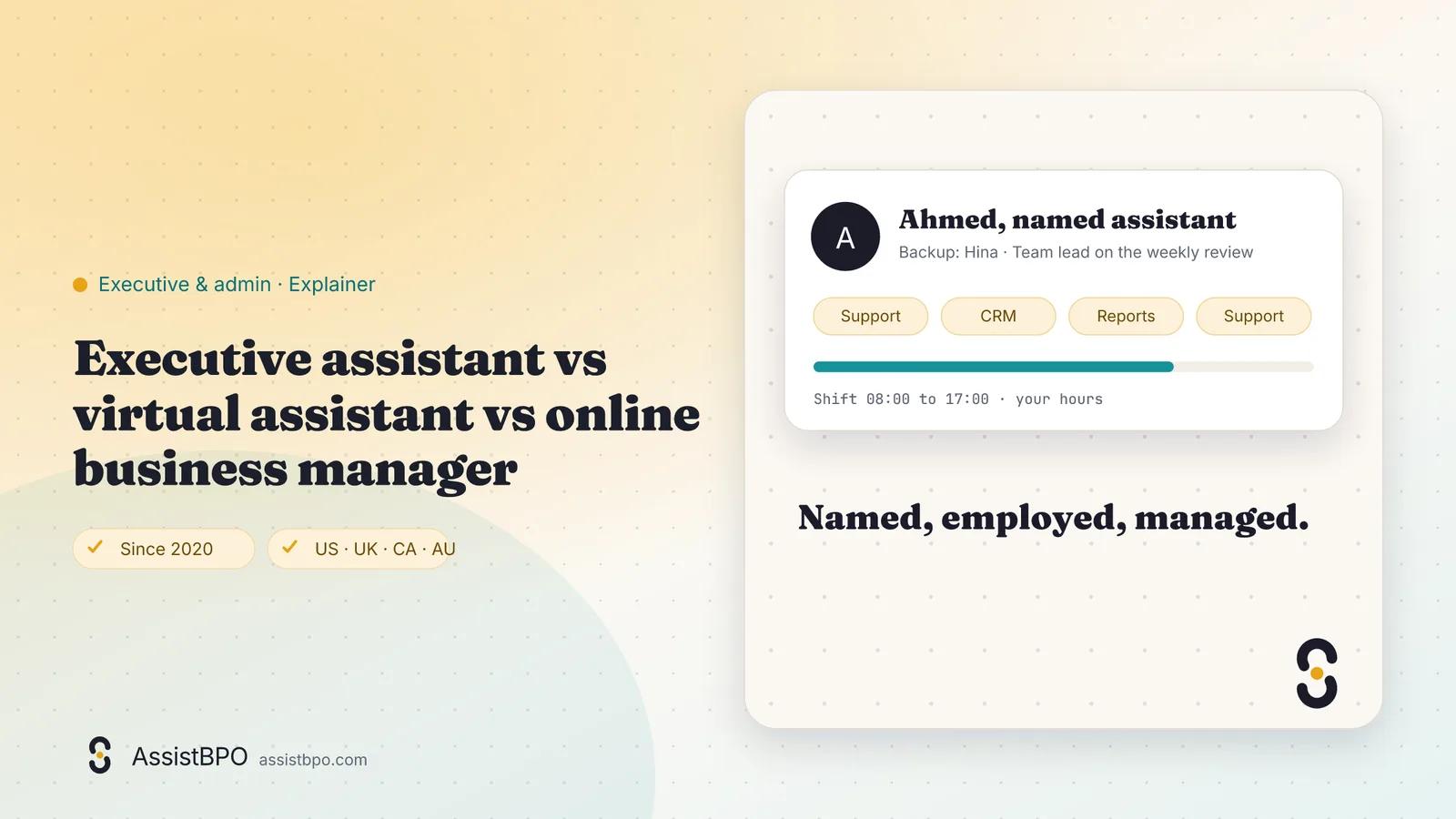
AssistBPO staffs the assistant and executive assistant layer with dedicated, employed staff working your hours, with a named assistant, a backup and a team lead so the desk is covered when someone is off. Plans depend on hours, desks and coverage. Get a staffing plan within 1 business day.
The short version: most businesses need a virtual assistant first, an executive assistant when the calendar becomes the constraint, and an online business manager only once there is a team and a process worth managing. Hire in that order and each role has something to stand on.
Frequently asked questions
What is the real difference between an executive assistant and a virtual assistant?
Scope and initiative. A virtual assistant works a defined task list: inbox triage, scheduling, data entry, research, documents. An executive assistant owns an executive's time and attention, which means gatekeeping the calendar, preparing the material before a meeting rather than after, managing follow-ups across the leadership team and making small judgment calls without checking in. Both can be remote. The difference is not location, it is how much the person decides on their own.
What does an online business manager actually manage?
The operation rather than the owner. An OBM typically owns projects end to end, runs the metrics dashboard, writes and enforces SOPs, manages other assistants and contractors, and holds the weekly leadership rhythm. They are accountable for outcomes such as a launch shipping on time or a support queue staying within target. An assistant is accountable for tasks. That is why an OBM usually sits above one or more VAs rather than replacing them.
How many hours does each role usually need?
A virtual assistant commonly starts at 20 hours a week and moves to 40 once the process list is written. An executive assistant supporting one busy executive is usually 30 to 40 hours a week, or 20 if they support a founder with a light meeting load. An online business manager is most often a retainer of 10 to 20 hours a week, because the work is direction, review and unblocking rather than production. Start smaller than you think and scale on evidence.
How much should each role cost in 2026?
PayScale puts the average US virtual assistant at $19.45 an hour with a range of $12 to $30, and Indeed reports $27.15. Managed offshore assistants run $7 to $15 an hour, or $640 to $2,400 a month full time, per the Wishup 2026 cost guide. Premium US executive assistant services publish about $65 an hour, with specialists at $79. In-house executive assistants cost $4,700 to $9,100 a month once benefits and overhead are loaded in.
Can one person cover all three roles?
Early on, yes, and many businesses run that way for a year or more. It stops working at a predictable point: when the assistant's own task list is full enough that managing anyone else means dropping something. At that moment you either promote them and hire beneath them, or you split the roles. Trying to keep one person doing both usually produces a stressed assistant and an operation where the improvement work never happens.
Which one should I hire first?
A virtual assistant, almost always. Spend two weeks logging what you do, then hand over the repeatable half. That exercise tells you far more than any job description. If, after 90 days, the bottleneck is your calendar and your meeting prep, you need an executive assistant. If the bottleneck is that projects stall and nobody owns the follow-through, you need an online business manager. Plans depend on hours, desks and coverage. Get a staffing plan within 1 business day.
Sources
- PayScale, Virtual Assistant hourly rate, United States, 2026
- Indeed, Virtual assistant salary in United States
- US Bureau of Labor Statistics, Secretaries and administrative assistants
- US Bureau of Labor Statistics, Receptionists
- Wishup, How much does a virtual assistant cost (2026 cost guide)
- Wishup, The 2026 Virtual Assistant Industry Report
- Boldly, pricing for executive assistant services
- Athena, pricing