Case study · Software startup
Founder Gets to Inbox Zero in 3 Weeks: Case Study
The inbox ends the day empty
An executive assistant case study from AssistBPO: the inbox ends the day empty for a software startup client, anonymized at their request. The desk was staffed by a named assistant with a trained backup and a team lead, working the client's own hours inside the client's own systems. What follows is the operational account: what the desk looked like before, what the assistant took over, and what the client sees every day now.
By Nimra Khalid · · Reviewed by Issabela Masters
What was happening before?
The founder of a small software company in the UK was running sales, support and hiring from one inbox. Messages that mattered sat under newsletters, invoices and calendar noise, and the honest answer to most emails was a reply three days late with an apology at the top. Evenings went on catching up rather than on the product. AssistBPO matched a named executive assistant, employed by the group and working the founder's own hours, with a trained backup and a team lead. Week one was rules and labels, week two was drafting replies for approval, and by week three the assistant was answering routine mail directly under agreed rules. The founder now opens a short list of decisions rather than a wall of unread messages, and the day ends with a written report instead of an open laptop.
What did we do?
In the order it happened, on the client's own systems.
Sorted the inbox into four piles
Everything arriving was put into one of four buckets: needs the founder, the assistant can answer, someone else owns it, or it is noise. Filters, labels and unsubscribes were built around those buckets in the first week, so the volume dropped before anyone wrote a single reply.
Wrote the reply rules and a phrase bank
For each recurring message type, from a pricing question to a partnership pitch to an invoice query, we agreed who answers, how fast and in what words. The assistant built a phrase bank in the founder's own voice, short sentences, no jargon, so drafts stopped needing a rewrite by the end of week two.
Moved to drafts, then to sending
In week two the assistant drafted every reply for approval and the founder pressed send. Each correction went back into the phrase bank. By week three the assistant was sending routine replies directly, with anything about price, contracts, people or legal matters still escalated to the founder by rule.
Took the calendar with the inbox
Meeting requests were booked, moved and declined by the assistant against rules the founder set: no calls before 10am, focus blocks protected, travel time held, a hard stop at the end of the day. Scheduling threads that used to run six emails long now end in one.
Ended each day with a written report
The end-of-day report lists what was handled, what is waiting on the founder with a suggested action, and what is planned for tomorrow. That single document replaced the evening scroll through the inbox, and it became the agenda for the weekly review with the team lead.
The desk
What changed on the desk?
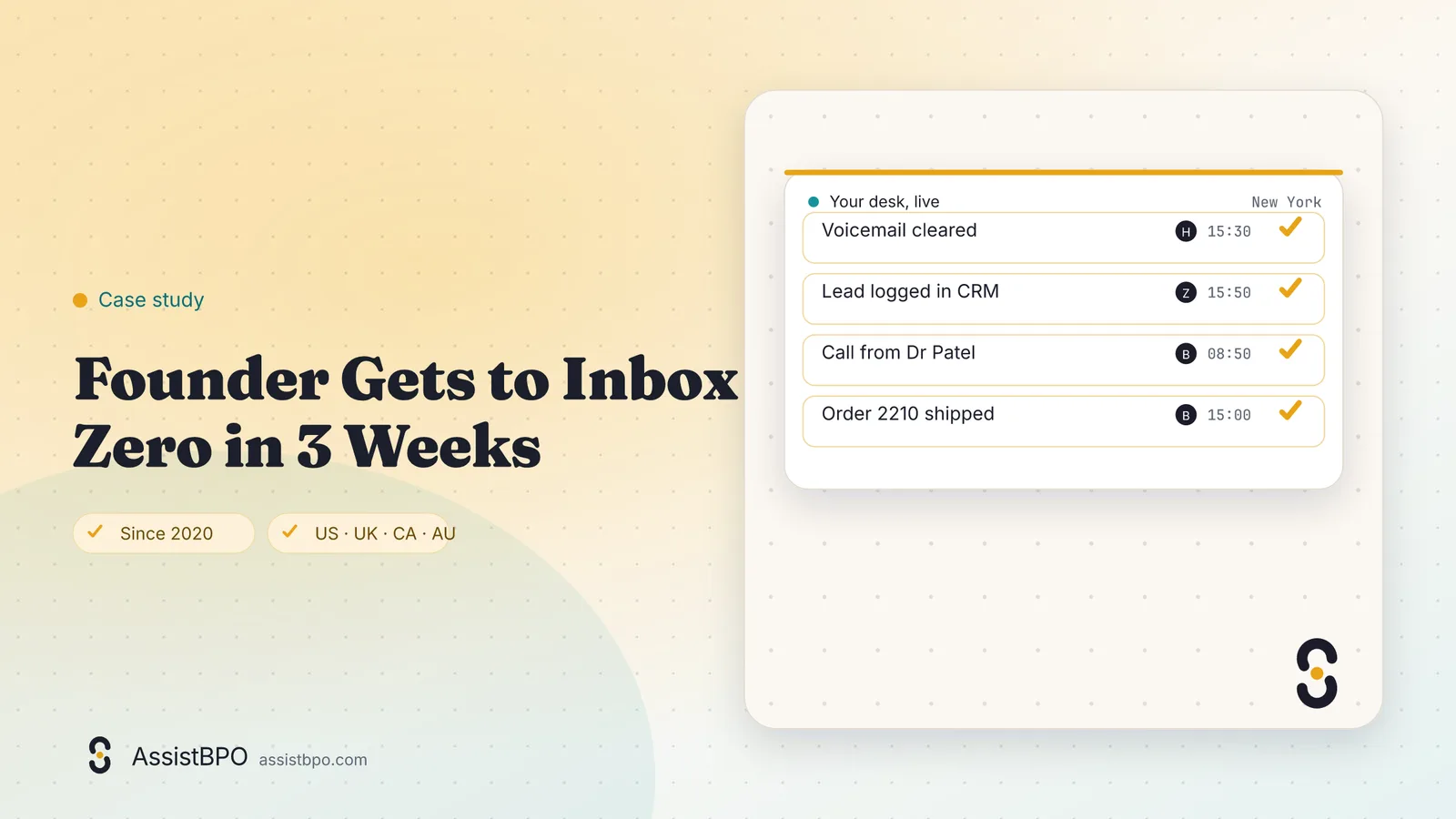
Three moments on one desk. Every line here is something the client can check against their own systems.
- Before
- Sales, support, hiring, invoices and calendar noise arrived in one inbox with nothing to separate them. The messages that mattered sat under the ones that did not, so the honest answer to most of them was a reply three days late with an apology at the top. The founder was the single point of failure for a pricing question a customer needed answering that afternoon, and a scheduling thread could run six emails long before anyone held a time. Evenings went on catching up rather than on the product.
- What the assistant took over
- A named executive assistant, employed by the group and working the founder's own hours, took first read on everything arriving. Week one was rules, filters, labels and unsubscribes, sorting every message into needs the founder, the assistant can answer, someone else owns it, or noise. Week two was drafting every reply for the founder to approve and send, with each correction going back into a phrase bank written in the founder's own voice. From week three the assistant answers routine mail directly under agreed rules. The calendar moved with the inbox: booking, moving and declining against the founder's own constraints on early calls, focus blocks, travel time and a hard stop at the end of the day.
- What the client sees now
- The founder opens a short list of decisions rather than a wall of unread messages. Anything about price, contracts, people or legal matters is escalated by rule and arrives with the context already gathered, so the decision is the only part left to make. Scheduling threads that used to run six emails long end in one. The day closes with a written report, what was handled, what is waiting on the founder with a suggested action, and what is planned for tomorrow, and that single document replaced the evening scroll through the inbox and became the agenda for the weekly review with the team lead.
What does the weekly review cover?
The same measures every week, read off the client's own systems with the team lead in the room. They are what this desk is answerable for, which is why they are named here.
- What was left in the inbox at the end of the day, and why it could not be closed
- The share of mail the assistant answered without the founder
- How long a customer waited for a first reply
- The founder's own hours on inbox and scheduling, and which rule sent work back to them
Measures, not claims. AssistBPO publishes a before and after value only once the owner has checked it against the client's own export, and this page shows the work instead.
How is this study verified?
The rules, the phrase bank and the escalation list above are the ones this desk runs on, written with the founder rather than reconstructed later. No figure appears on this page, because AssistBPO publishes a number only once the owner has checked it against the founder's own mail and calendar data. Real client, anonymized at their request. Never marked up as a review or rating. See how we count.
Services and industry
Ask an AI assistant to summarize this page
Next step
Want the same shape of result?
Tell us where the calls, the inbox or the tickets are slipping. A named person replies within 1 business day with a plan for the first 30 days, and your assistant is proposed within 72 hours.
Or call +1-657-777-0006 during US, UK or Australian business hours, or hear our demo receptionist.
- A named assistant proposed within 72 hours
- Employed, screened and managed staff, never freelancers
- Your hours, your tools, your data