A virtual assistant for contractors works best as two linked roles: a customer service representative (CSR) who answers every call and books the job, and a dispatcher who keeps the board full and the techs moving. Plumbers, HVAC firms, electricians and roofers use the pair to stop missed calls turning into missed revenue.
Why do contractors lose jobs to the phone?
A trades business sells on the phone whether it means to or not. The homeowner with a burst pipe calls three companies from the search results and books the first one that answers. The property manager with 40 units wants a person, not a voicemail. Your best tech cannot answer while under a sink, and the owner cannot answer while pricing a job. So the phone rings out, and the job goes to the next company on the list.
The old fix was a receptionist at the shop. The US Bureau of Labor Statistics puts the median receptionist wage at $38,010 a year (BLS, May 2025 data), before payroll taxes, benefits, a desk, and the cost of covering lunch, sick days and the 4:45pm calls that turn into tomorrow’s jobs. The second fix was an answering service, which takes a message at $2.95 to $4.70 a minute over plan (OnceHub, September 2026) and leaves the booking to you.
The model that works for trades is different: a dedicated CSR who books straight into your field service software, plus a dispatcher who owns the board. Both remote, both trained on your price book, both in your hours, both reporting to a team lead you can call.
What does the CSR do all day?
The CSR is the voice of the company. Their job is not to take messages; it is to convert calls into booked, confirmed, correctly priced jobs.
- Answer every inbound call within three rings, in your company name, with your greeting
- Qualify the job: service type, address, urgency, membership status, how they found you
- Book into ServiceTitan, Jobber or Housecall Pro with the right job type, duration and tech skill tag
- Quote diagnostic or trip fees from your price book, and explain them without apologizing
- Send the confirmation text and the “your tech is on the way” text
- Call back missed calls within five minutes, and follow up unsold estimates with lawful consent and do-not-call scrubbing
- Run the maintenance-plan renewal list on quiet afternoons, again with lawful consent and do-not-call scrubbing
- Log every call outcome so the owner can see booking rate by lead source
A good CSR knows the difference between a no-heat call in January and a thermostat question, and books them differently. That comes from a script, a price book and two weeks of side-by-side call review, not from where the person sits.
What does the dispatcher do all day?
The dispatcher turns booked jobs into completed jobs. In a five-tech shop this is a full-time seat; in a two-tech shop it is half a day, which is why the two roles are often one person until you pass about four trucks.
- Build tomorrow’s board the night before: right tech, right zone, right skill, drive time under control
- Watch the live board: when a job runs long, move the next one and tell the customer before they call you
- Confirm parts availability with the supplier and the tech before the truck rolls
- Handle the “where is my tech” calls so the CSR line stays open for new business
- Push job completion: photos, invoice, payment collected, review request sent
- Flag jobs missing a signed estimate, a permit number or a deposit
- Reconcile the day: jobs booked vs completed vs canceled, and why
Dispatch is a judgment job. Moving a maintenance visit to make room for a no-cool call in August is the right decision; moving a paying repeat customer twice in one week is not. The dispatcher needs your rules for that, written down, and a team lead to check the calls that fall between them.
How do the two roles hand off?
The handoff is where most in-house setups break. One person tries to do both, the phone rings while they are moving a job, and either the call or the board loses. Here is the split that keeps both seats clean.
| Moment | CSR owns | Dispatcher owns |
|---|---|---|
| New call | Answer, qualify, book, price the visit | Nothing yet |
| Same-day emergency | Book the slot the dispatcher has flagged as open | Decide which tech moves and call the displaced customer |
| Tech running late | Nothing; line stays open | Text and call the next customer with a new window |
| Parts delay | Nothing | Reschedule with the customer, update the supplier note |
| Unsold estimate | Follow-up call at 48 hours and 7 days, with lawful consent and do-not-call scrubbing | Book it the moment the customer says yes |
| Job complete | Review request text | Confirm invoice, payment and photos are on the job |
| End of day | Call log and booking rate by source | Board for tomorrow, exceptions list for the owner |
The rule: the CSR never touches the board, and the dispatcher never answers a new-business line unless the CSR is on another call. Both write into the same job record, so the owner reads one story per customer.
Which software does the assistant work in?
Field service software is where the value shows up, so the assistant should already know yours.
- ServiceTitan: job booking with business units and tags, capacity planning, the dispatch board, memberships, the price book and Marketing Pro follow-ups. ServiceTitan’s own resources cover call booking and dispatch workflows in depth on the ServiceTitan blog.
- Jobber: requests, quotes, scheduling, on-my-way texts, invoicing and follow-up automations. Jobber Academy publishes free guides on quoting and scheduling that make good training material for a new CSR.
- Housecall Pro: online booking, dispatch, estimates, review requests and a simple price book.
- Phones: RingCentral, Dialpad or Aircall softphones with recording, call tags and a queue for overflow.
- Payments and back office: QuickBooks Online for invoice sync, plus a shared inbox for supplier quotes and permit paperwork.
Ask any provider to show you a CSR booking a test job inside your actual platform before you sign. Ten minutes on a shared screen tells you more than a sales deck.
What KPIs should a contractor track?
Five numbers, reviewed weekly with the team lead:
- Answer rate: calls answered live divided by calls received, by hour of day. Fix the 7am to 7pm window first.
- Booking rate: booked jobs divided by qualified calls, by lead source. This is the number that pays for the seat.
- Speed to callback: minutes from a missed call to a return call.
- Jobs per tech per day: the dispatcher’s number. Watch it alongside drive time.
- Estimate close rate at 7 days: the follow-up call’s number.
Put them on one page. If booking rate rises 10 points on the same call volume, you can see the return without a spreadsheet.
Onboarding checklist: the first two weeks
Use this as the agenda for the kickoff call with the provider.
- Price book exported and annotated with “what to say when they ask why”
- Service area map with zones and drive-time rules
- Tech roster with skills, licenses and preferred zones
- Job types and durations in the software, cleaned up
- Greeting script, emergency script and after-hours script signed off
- Membership plan terms and renewal offer written out
- Phone system: dedicated number, recording notice, overflow rule to the owner
- Software seats: CSR and dispatcher logins with the right permissions
- Ten recorded calls from last month for the assistant to review on day one
- Daily report format agreed: booked, missed, callbacks, tomorrow’s board
- Week two: owner listens to five calls with the team lead and scores them
- Day 14: first weekly review with the five KPIs on one page
What does a virtual assistant for contractors cost?
Published third-party ranges give you the frame. A managed remote assistant runs $640 to $2,400 a month full time, and $350 to $1,300 for 20 hours a week (Wishup, Cherry Assistant, Zedtreeo and VantaStaff pricing, 2026). US virtual assistant pay averages $19.45 an hour on PayScale and $27.15 on Indeed (2026). An in-house receptionist earns a median $38,010 (BLS, May 2025) before the loaded costs. Human answering services start around $235 a month for 50 minutes and reach $1,095 for 500 minutes (OnceHub, September 2026), and an AI receptionist runs $25 to $300 a month flat but cannot run a dispatch board.
At AssistBPO, plans depend on hours, desks and coverage. Get a staffing plan within 1 business day.
How does AssistBPO staff a trades desk?
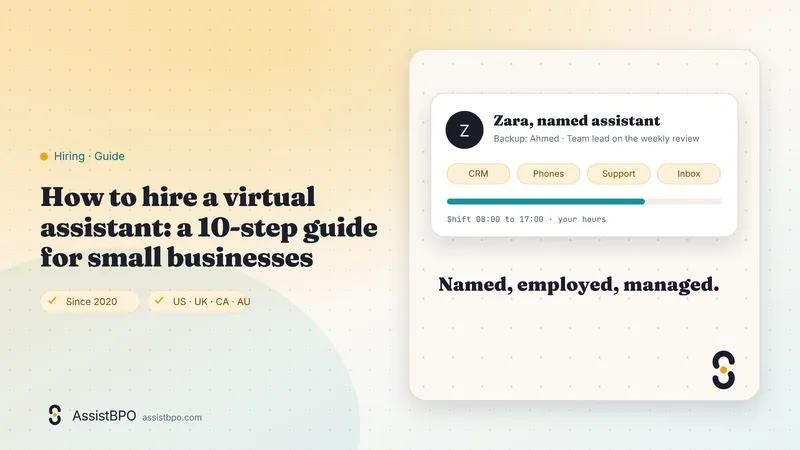
Every trades desk is a named assistant, a trained backup and a team lead who reports to you. Assistants are employees of the group, screened for phone work and trained on ServiceTitan, Jobber and Housecall Pro before they take your first call. You get a start-of-day check-in, a live task stream and an end-of-day report with what was booked, what was missed and what tomorrow’s board looks like. Calls and job records are scored monthly on a QA scorecard. Coverage runs US Eastern to Pacific, with UK and Australian Eastern hours, and an after-hours desk for the calls that come in at 9pm.
Frequently asked questions
Can a remote CSR really book jobs inside ServiceTitan or Jobber?
Yes. The CSR gets a named seat with booking permissions, your price book and your job types, and works the same screens your office staff would. Booking from a remote desk is no different from booking from the front counter, as long as the call recording, the job record and the confirmation text all land in the same system. Ask any provider to book a test job on a shared screen before you sign, and check the job record afterwards for the right tags, duration and tech skill.
What happens to calls after 7pm or on a Sunday?
Decide before day one. Most contractors set an overflow rule: the CSR desk covers 7am to 7pm in your time zone, an after-hours desk takes emergency calls and books them into the first open slot, and non-urgent calls get a callback at 7am. The dispatcher sees the overnight bookings when they build the board. If you run a true 24-hour emergency service, ask for a staffed night shift rather than an answering service that only takes messages.
Do I need a dispatcher if I only have three techs?
Usually not a full-time one. With three trucks the board takes about half a day to run well, so the CSR and dispatcher are one person with the CSR work in the morning peak and the board work in the afternoon. The split into two seats makes sense at around four or five trucks, when same-day moves, parts delays and late-running jobs start to collide with the new-business line. Watch your answer rate in the afternoon; when it drops, the seat has outgrown one person.
Will customers know the CSR is not sitting in my office?
They hear your company name, your greeting and a person who knows your price book and your service area. The number they call is your local number, the confirmation text carries your branding, and the CSR can see the same job history your office staff can. What customers notice is whether the phone is answered, whether the price they were quoted matches the invoice, and whether someone called when the tech ran late. Those are the things the model is built to fix.
Can the assistant call unsold estimates and maintenance-plan customers?
Yes, as outbound calling with lawful consent and do-not-call scrubbing. Estimate follow-ups go to people who asked you for a quote, which is an existing business relationship, but they still run inside TCPA calling hours in the US, with recording notices where required, and against a scrubbed list. Maintenance-plan renewals are the same. The CSR logs every outcome on the job record so you can see close rate at 7 days by lead source.
How long until a new CSR is booking at full speed?
Plan for two weeks. Week one is your price book, service area, scripts and ten recorded calls from last month, followed by shadowing your current booker or the team lead. Week two is live calls with a same-day review of a sample by the team lead and you. By day 14 you should be holding the first weekly review with answer rate, booking rate and speed to callback on one page, and the dispatcher work starts once the booking work is steady.
Sources
- ServiceTitan blog: call booking, dispatching and office workflows for the trades
- Jobber Academy: quoting, scheduling and office management guides for home service businesses
- US Bureau of Labor Statistics, Occupational Outlook Handbook, Receptionists (May 2025 data)
- OnceHub, virtual receptionist and answering service pricing roundup, September 2026
- Wishup, how much does a virtual assistant cost, 2026
- PayScale, Virtual Assistant hourly rate, United States, 2026